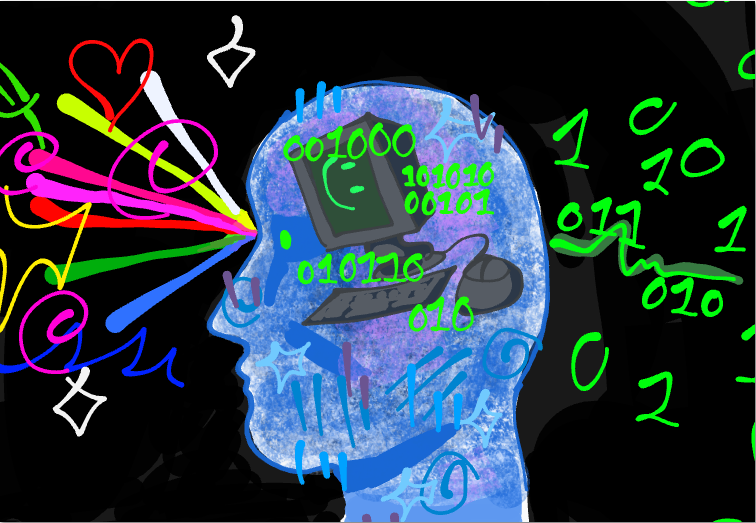
It’s a question raised by students and teachers alike, especially since the creation of the popular AI assistant ChatGPT. Artificial intelligence has become increasingly accessible in recent years, so should we utilize it, or avoid it in the effort to prioritize human ingenuity?
How did AI Get Its Start?
AI had its beginnings way back in 1950, when the English mathematician Alan Turing created the “Turing Test” to determine if a machine was capable of thinking on its own. It was an imitation game, and if the participant was able to figure out who was the machine and who was the human, the computer would be considered to have “artificial intelligence”.
Over the next few years, the field of artificial intelligence grew wider as it began being funded by the Department of Defense by the mid-1960s. The popularity of the field grew weaker until the late 1990s and early 2000s, when AI research had a resurgence, and it’s become stronger than ever. Computers are faster, smarter, and able to compute tons of data in the blink of an eye.
The Dawn of ChatGPT
ChatGPT is by far the most famous AI around today. But where did it come from, and why is it so famous?
The first version — albeit an early demo —was released on November 30, 2022. It went viral on social media for its usefulness, enticing over one million users to the bot within the first five days. From planning out a vacation to helping out with math homework, ChatGPT seemed like the answer to all of our problems.
The fourth version, “GPT-4”, released in 2023, is the latest and smartest version of the chatbot. It is factually accurate, can understand the intentions of the user, and can search the Internet from within the program. It can plan out a to-do list, give you dinner ideas, and most important of all, it can do your math homework.
In this digital age, we have access to so much technology that our parents sometimes have trouble keeping up. In fact, we are swimming in it. It seems like every day a new iPhone comes out (is there really a difference between them anymore?) and a new app is trending.
Especially as inhabitants of America, we are in a privileged position to be able to have all of this information at our fingertips. So the question isn’t “can we use AI, it’s “should we use AI?”
It’s a machine built by humans, so why not? Either you jump on the train like everyone else, or be left behind in the dust. But unfortunately, it’s more complicated than that.
It’s ironic how when I search for “Dangers of AI” on google, I get an AI overview of its dangers. It seems like AI is everywhere now, with even the simplest of searches having AI at the top of the page to simplify the information. Why should the information be simplified? As students, our job is to think for ourselves, not ask a chatbot to do it for us.
Our reliance on AI will lead to our own downfall. Not being able to think for ourselves to understand something complex, such as a piece of literature, will create gaps in our knowledge that only a chatbot can fill. Especially as America faces a literacy crisis, understanding the importance of education is powerful and taking the opportunity to learn using one’s own brain is a luxury that a lot of people don’t have.
By asking AI to aid us with mundane tasks, we are shifting our reliance on our own thinking to the machine. We take the recommendations it gives us in a heartbeat, without taking a moment to understand that we are taking advice from a machine. Some variations of chatbots such as character.ai even allow users to chat with a character of their choosing, resulting in some odd exchanges between the user and the bot.
This level of dependence on AI will lead to our downfall, especially as our attention spans get shorter and we are no longer able to handle long tasks. Why can’t we spend more time analyzing literature, or understanding a math problem by ourselves? If we could do it 3 years ago, then we can certainly handle it now.
Here’s my advice: In a world filled to the brim with AI usage, be that beacon of light. Human ingenuity and effort will always shine brighter. There’s a certain glow of complexity that comes from the human brain, and work made organically will always reign supreme.
So put down that chatbot and start thinking!